
By Maximiliano Bazán. Published by CIPER Chile, March 15, 2026. Photo by Daniel Casado / Translated with DeepL.com
In the following column, the author argues that Australis, Blumar, and Cermaq have made millions of dollars in payments to the former head of the Aquaculture Division of the Subpesca, Eugenio Zamorano, since he left his post in 2022 to promote a proposal that has just been approved by the same agency and that allows them to intensify production at 55 fish farms located in the Magallanes region, without an environmental assessment. The Comptroller’s Office ruled out any breach of integrity because Subpesca is not a regulatory body, unlike Sernapesca, whose deputy legal director at the time was Jessica Fuentes—also Zamorano’s partner—and who appears as the document’s author, a detail the Comptroller’s Office failed to review. Today, both work at Acuiestudios alongside other former high-ranking officials from Subpesca and Sernapesca.
*Subpesca = Undersecretariat of Fisheries and Aquaculture of the State of Chile / Sernapesca = National Fisheries and Aquaculture Service of Chile
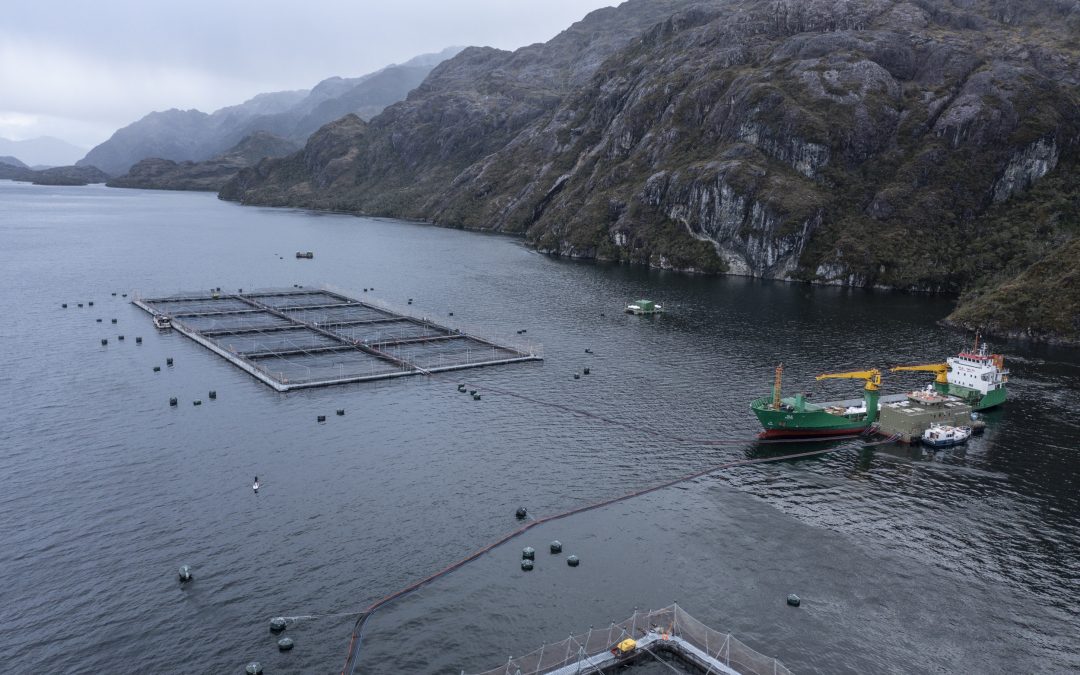
On January 14, the Undersecretariat of Fisheries and Aquaculture (Subpesca) approved the subdivision of six Salmon Concession Groups (ACS) or districts, which comprise 55 fish farms —all located in the Magallanes region—to form 16 new districts, which implies a change in the production timing of the farming centers in favor of three companies, which will be able to increase their production at the cost of greater health and environmental risks.
The process originated from a proposal by the head of Subpesca’s Aquaculture Division during Piñera’s second administration, Eugenio Zamorano, drafted between March and May 2022, just days after he left his position at the regulatory agency on March 11 of that year. This was in exchange for a monthly payment of 150 UF (currently 6 million pesos) with a bonus of 400 UF (currently 16 million pesos) for each original subdivision, according to documents that were reported to the Comptroller General of the Republic.
According to the reported records accessed as part of this investigation, the Word document containing the proposal sent to the companies Australis Seafood, Blumar, and Cermaq was originally created on March 20, 2022, in the account of user Jessica Fuentes—at the time deputy legal director of Sernapesca, the regulatory body for the salmon industry, and also Zamorano’s partner—and was later edited by user Eugenio Zamorano on May 20, 2022, who ultimately emailed it that same afternoon to the representative of one of the three companies.
Creation and revision history of the proposal for the subdivision of salmon farming districts
According to records from the Ley del Lobby platform, Jessica Fuentes’s last session as deputy legal director of Sernapesca was on December 29, 2022, and her contract expired on January 3, 2023. Meanwhile, Eugenio Zamorano stepped down from his position as head of the Aquaculture Division at Subpesca on March 11, 2022.
These facts raise some questions: Was it Zamorano or Fuentes who drafted the original proposal for the companies while serving as deputy legal director of the regulatory agency (Sernapesca), which was then required to approve that regulatory amendment before it was adopted by Subpesca, as stated in the proposal itself?
Does the fact that she had just left the leadership position that was supposed to participate in the decision to subdivide the salmon farming districts constitute a breach of integrity? Did Zamorano maintain privileged access to networks—former subordinates—and information within Subpesca and Sernapesca—where her partner continued to work—that could influence decisions in favor of the companies that hired her?
To answer these questions, Eugenio Zamorano was contacted, but he declined to participate in the interview, noting that he was unaware of the complaint filed against him with the Comptroller’s Office—whose ruling will be addressed later in this investigation.
For her part, Jessica Fuentes said: “I did not participate in drafting the proposal, so it is clear that there is no breach of administrative integrity.”
Four days after Zamorano sent the proposal, on May 24, 2022, a representative from Blumar—one of the three contracting parties, along with Australis and Cermaq—replied to the email, confirming the contract while also including two additional ACS sites to be subdivided and, incidentally, reducing the monthly payment by 100 UF from what the former head of the Aquaculture Division at Subpesca had requested.
To determine how much was paid for the contracted services, whether Jessica Fuentes was involved in the original proposal, and the impact of the subdivision on production, we contacted representatives from Australis, Cermaq, and Blumar. They did not answer any of these questions, but they did send a brief joint statement, which is reproduced in full below.
As an estimate, the 43 months over which the three phases detailed in the proposal spanned (150 UF per month), combined with the six ACS awards actually awarded (400 UF per award), amount to a total of $350 million pesos at the current value of the UF, equivalent to an average of $8 million pesos per month.
Despite the lack of responses from the parties involved, the public hearing platform under the lobbying law records that on July 23, 2025, alongside representatives from Blumar, Australis, and Cermaq, Zamorano met with Sernapesca’s Deputy Director of Aquaculture, Mónica Rojas, “to discuss the production plans of the three companies in relation to the latest coordinated sanitary rest periods established by Sernapesca resolution for the concession groups (ACS) in the Magallanes Region and the proposed subdivision of ACS currently under review and analysis by the Authority.”
More recently, on January 22, 2026, Zamorano himself attended a meeting with representatives from the same companies to meet once again with the deputy director of Aquaculture and the head of Animal Health at Sernapesca to “discuss issues related to the coordinated health closures of concession groups in the Magallanes Region.” This meeting took place one week after Subpesca approved the subdivision of the 6 ACS (January 14), and three weeks before Sernapesca modified the health breaks (February 18) as a result of the subdivision.
THE COMPANIES’ INTEREST IN SUBDIVIDING THE ACS
The Salmonid Concession Groups (ACS) emerged as part of the government’s response to the ISA virus crisis (2007–2010) through Law No. 20,434, which changed the salmon industry’s financial and operational model following the health crisis that led to a financial crisis. The industry’s revival was led by Felipe Sandoval, who was appointed president of the Salmon Board to address the crisis and later became the industry’s union leader, as well as Jessica Fuentes, in her role as an advisor to Office of the Secretary General.
Under this new framework, the ACSs were established to prevent health contingencies. Specifically, an ACS defines a zone comprising several salmon farming centers, within which coordinated health management is implemented. This includes mandatory measures as well as voluntary ones, in accordance with regulations, based on epidemiological, oceanographic, operational, and geographic characteristics that justify such coordinated health management.
Coordinated health management is expressed, for example, in Sernapesca’s determination of a three-month mandatory health rest period for each ACS, which occurs every two or three years. This means that no farming facility within the respective ACS or neighborhood may maintain operations during that period, thereby affecting the companies’ production schedules.
According to a former executive of a salmon farming company consulted as part of this investigation, who preferred to remain anonymous, decoupling the production cycles of a single ACS allows production to be spread out over time, thereby avoiding overstocking that could affect the selling price of salmon.
But there is another effect that is perhaps even more significant: the reduction in the time between one sanitary rest period and the next—or, in other words, the minimum period a company has to restart a production cycle—which affects productivity levels and, consequently, profits.
This is important for facilities that produce Atlantic salmon (the main species farmed in Chile), since they can only complete one production cycle between health rest periods; and by shortening the time between each rest period by six or 12 months—as is the case with several of the subdivided ACS facilities—companies can further intensify their production. This means more salmon in grow-out, more antibiotics, more feed, and more feces accumulating on the seabed over the same period of time, and in an area where, as the sanitary breaks are decoupled, there are effectively no breaks at all.
In other words, by reducing the period between one health break and the next from 33 to 21 months, after six years, each farm located in that zone or ACS will be able to complete three production cycles where previously it could only do two—a cycle being the fattening process until the salmon are harvested at sea. This means that if a farm is authorized to produce up to 5,000 tons of salmon per cycle, with this modification made at the companies’ request, it will be able to increase its production from 10,000 to 15,000 tons over that same six-year period.
In short, the subdivision of these six Salmonid Concession Groups (ACS) into 16 new districts will allow these three companies to make more efficient use of their assets (processing plants, farming infrastructure, workers, etc.) and increase production, but at the expense of ecosystem health and with greater health risks.
CONTENTS OF THE AMENDMENT
Of the eight Salmonid Concession Groups (ACS) initially agreed upon for subdivision (45, 48A, 49B, 50A, 50B, 51, 52, and 53), six were ultimately established (49A, 49B, 50B, 51, 52, and 53), subdivided into 16 new ACS, which together comprise 55 farming sites (see map): 26 belonging to Australis; 13 to Cermaq; nine to Blumar; four to Trusal; and three to Aquachile. It should be noted that these last two companies did not participate in the contracting process, likely because Trusal leases its concessions to Cermaq and Blumar, while Aquachile has no harvests recorded in these concessions between 2001 and 2024; however, they did approve the proposal.
One notable point is that it was not until October 2025, through Resolution No. 2384, that the Subpesca updated Resolution No. 2440 of 2024, which establishes the salmon farming zones, subsequently publishing a schedule of the sanitary rest periods for each of them starting in 2026. However, due to a request from these three salmon farming companies that was being processed in parallel—and which is documented in the lobbying hearings mentioned above—the Subpesca’s Aquaculture Division ultimately agreed to validate the subdivision of the six zones, recording this in Technical Report No. 13 of January 8, 2026, in which it requested Undersecretary Julio Salas to approve said modification, which would finally be enacted on January 14, 2026, through Resolution No. 101.
Finally, following the approved subdivision, Sernapesca published on February 18 a new schedule of mandatory rest periods for each ACS, modifying the one it had recently published, and agreeing to the proposal to stagger the months of sanitary rest periods among the subdivided ACSs and shorten the number of months between them, thereby enhancing the productive output of the concessions.
To obtain details of the procedure, a request was made under the Transparency Act for the file regarding the modification of salmon farming zones, including the applications submitted by the companies. The response from the Sub-Secretariat of Fisheries arrived after the legal deadline of 20 business days, and denied access to the information, arguing that after notifying the companies, they “formally expressed their opposition to the release of the requested information, invoking the grounds of secrecy or confidentiality provided for in Article 21(2) of Law No. 20,285, on the grounds that the release could affect rights related to commercial or economic information.” When asked about the procedure, Subpesca stated that everything was in order and that it followed an “evaluation process based on information and technical analysis”.
Schedule of health breaks for subdivided ACS units
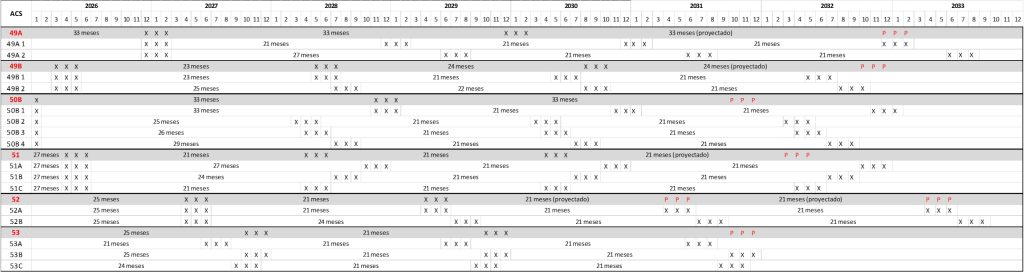
The original ACS areas that were subdivided are shown in red. “P” (in red) indicates the projected location of the next sanitary break if no subdivision had taken place. Source: Prepared by the author based on information from Sernapesca.
Map of the original ACS areas and the new ACS areas resulting from the subdivision
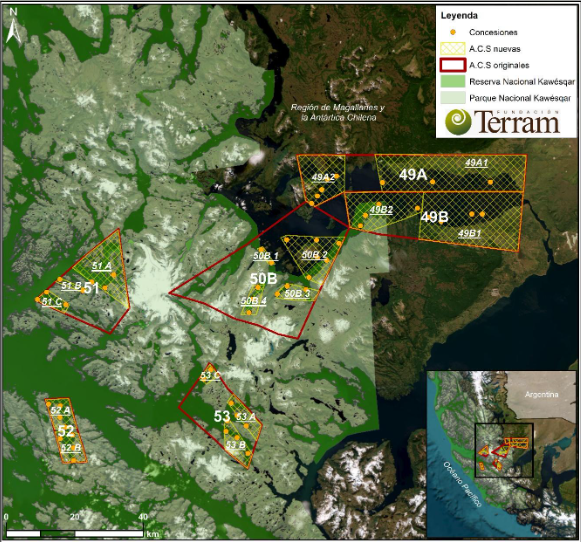
Source: Prepared by Pablo Madrid, geographer at Fundación Terram, based on information from the Subpesca contained in Resolution 101/2026 and the National Aquaculture Registry (RNA).
INTENSIFICATION OF PRODUCTION IN PROTECTED AREAS WITHOUT AN ENVIRONMENTAL ASSESSMENT
Of the 55 aquaculture centers that make up the subdivided ACSs and whose production may be intensified, 39 are located within the Kawésqar National Reserve, an area where the growth and expansion of the industry is currently suspended, pending the management plan to be published by the Service for Biodiversity and Protected Areas (SBAP).
According to Article 72(h) of Law No. 21,600, the management plan must specify “activities that are compatible and incompatible with the area.” Thus, since the enactment of this law in September 2023, the granting of new salmon farming concessions or the expansion of production at farming facilities—which must undergo an environmental assessment—has been suspended until the management plan determines whether industrial salmon production is compatible with the reserve’s conservation objectives, which, according to Article 64, are “the species, ecosystems, ecosystem services, or ecological functions or processes that are intended to be protected through the creation of the area.”
This is how, through the ACS subdivision, companies found a regulatory loophole that allows them to intensify production, even when the protected area does not have a management plan in place, since by staggering the rest periods and reducing the time between them, each farm will be able to carry out more production cycles in a shorter period of time.
COMPTROLLER’S OFFICE DISMISSES COMPLAINT REGARDING BREACHES OF INTEGRITY
Article 56 of the Organic Constitutional Law on General Principles of State Administration establishes that “the activities of former authorities or former officials of an oversight agency that involve an employment relationship with private-sector entities subject to that agency’s oversight are incompatible. This incompatibility shall remain in effect for up to six months after their term of office has expired.”
Based on the facts presented in this investigation, in September 2025, a complaint—filed anonymously—was submitted to the Regional Comptroller’s Office of Valparaíso regarding possible breaches of integrity by the former head of the Aquaculture Division of the Sub-Secretariat of Fisheries.
Finally, on January 31 of this year, the complaint was dismissed by the Comptroller’s Office. “Since the Undersecretariat of Fisheries and Aquaculture is not a supervisory body as referred to in the final paragraph of Article 56 of Law No. 18,575, the aforementioned former official of that entity, Mr. Eugenio Zamorano Villalobos, is not subject to the incompatibility established in that legal provision,” the agency concluded. / Read the Comptroller’s Office’s full statement here.
Although Sernapesca is responsible for regulating the salmon industry, Subpesca makes decisions that have even more significant implications, such as approving the technical plans for farming facilities—which determine production volumes—and authorizing stocking densities at the start of each production cycle based on a health assessment of those facilities, along with defining the ACS, so that Sernapesca can then establish health rest periods, which determine the timing of production, among other strategic decisions for the industry.
This raises the question of whether the Comptroller’s ruling is overly restrictive by failing to consider de facto elements when evaluating Subpesca’s role in the salmon industry, or whether the problem lies in the law itself, by limiting the scope of administrative probity solely to former officials of strictly supervisory agencies, leaving a loophole that opens the revolving door to those working in regulatory agencies, such as Subpesca, but also applicable to other sectors, such as the mining, agricultural, or forestry industries.
One aspect that the Comptroller’s Office did not consider is that the document was authored—according to its history—by Jessica Fuentes, who was the deputy legal director of Sernapesca at the time the proposal was drafted, and who continued to work at that agency for several months after Zamorano—her partner—was hired. All these elements, while not sufficient proof of any breach, raise questions that have not yet been asked or investigated by the Comptroller’s Office, nor clarified by the parties involved in the context of this investigation.
That said, in the realm of fisheries and aquaculture, the revolving door does not begin or end with Eugenio Zamorano or Jessica Fuentes, as it is a widespread phenomenon spanning the administrations of both the former Concertación and Chile Vamos coalitions.
ACUIESTUDIOS OR THE REVOLVING DOOR OF THE FISHING AND SALMON INDUSTRY
“He has played a key role in the design and implementation of aquaculture regulations over the past 12 years. With experience at Sernapesca (2003–2007), IFOP (2007–2010), and the Undersecretariat of Fisheries and Aquaculture (2010–2022), he led post-crisis health regulation in 2010.” This is how Acuiestudios introduces Eugenio Zamorano—a veterinarian from the University of Chile—on its website. He recorded 430 lobbying meetings while serving as head of the Subpesca Aquaculture Division between 2014 and 2022.
During that period, two of the lobbyists he met with most frequently were Paolo Trejo Carmona (25 meetings) and José Miguel Burgos González (24 meetings), who, along with Germán Iglesias Veloso, are partners at Acuiestudios, perhaps the most influential consulting firm in Chile’s fishing and salmon industry, which Zamorano joined shortly after leaving Subpesca and, later, Jessica Fuentes upon leaving Sernapesca.
According to the platform that tracks meetings under the Lobbying Act, Acuiestudios has recorded a total of 130 meetings between 2019 and 2026, representing the interests of a wide range of companies.
According to information available on the Acuiestudios website, its team has accumulated significant experience in the public sector, specifically in leadership positions at Subpesca and Sernapesca over the past three decades, participating directly in the regulation and oversight of the fishing and salmon industries. A sort of parallel undersecretariat. / Read the full report on CIPER Chile [in spanish]