
Translated from Spanish using DeepL
Published on Mongabay.com by Benjamín Bravo, Nicolás Cerpa y Nicolás Sepúlveda, 5 de Marzo 2026. Image: Nicolás Sepúlveda.
- The databases of regulatory agencies contain hundreds of sanctioning proceedings involving the salmon farming industry.
- Mongabay Latam compiled and organized information on serious and extremely serious cases that caused environmental damage in the southernmost regions of Chile.
- At the same time, the industry resists oversight and complains in the press about excessive regulations that are allegedly slowing down its business.
- President-elect Kast agrees with the companies.
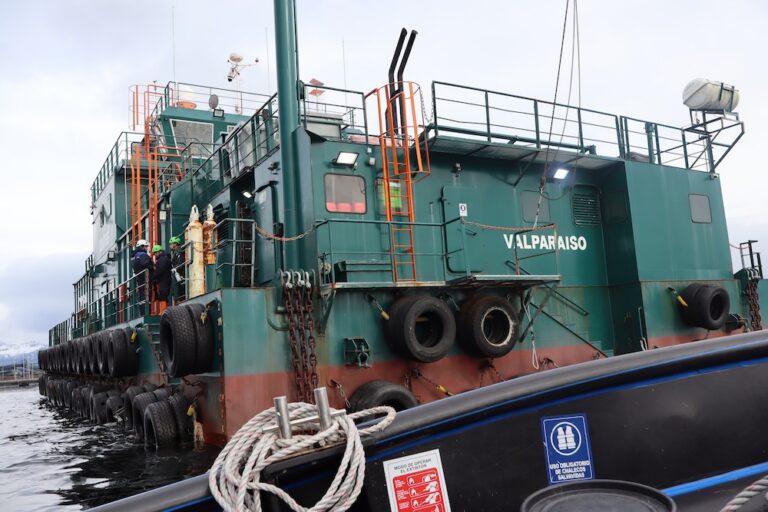
On Juan Island, in the Magallanes Region, Cermaq—owned by Japan’s Mitsubishi Corporation and the world’s third-largest producer of Atlantic salmon—manages its salmon fattening center from a pontoon overlooking a mountain range that brings snow and sea together in the landscape. A pontoon is a large boat with offices and warehouses, and from it Cermaq controls the eight cages where the 650,000 salmon they have in production at this center are raised.
On October 22, after a three-hour journey by land and sea from Punta Arenas, two inspectors from the National Fisheries and Aquaculture Service (Sernapesca) arrived at this pontoon with the mission of inspecting whether the company was complying with the regulations required by its environmental permit. But as has happened hundreds of times in recent years, the officials discovered three violations and one serious offense, for which they will file a complaint. Inside the pontoon’s offices, the inspectors notified the company’s representatives.
The salmon farming industry is one of the most economically important in the country, but for several years it has been at odds with regulatory agencies, a tension that has become a political issue.
Cermaq is a good example of this conflict. It controls a booming business: in 2024 alone, it earned $631 million thanks to the dozens of fish farms it operates in southern Chile, from where it exports salmon to the United States, Asia, and Brazil. But at the same time, it has accumulated 20 sanctioning proceedings with the Superintendency of the Environment (SMA), the agency responsible for ensuring compliance with environmental regulations.
This parallel is repeated throughout the salmon industry: multimillion-dollar revenues and a high number of complaints and sanctions for non-compliance.
The scientific and environmental communities criticize the salmon industry for causing permanent damage in the areas where it operates, while the industry responds that the damage is minor compared to the economic benefits it brings to the country. According to figures from Salmonchile, one of the salmon industry associations, its activity accounted for 1.7% of Chile’s gross domestic product in 2021.
How minor is the damage caused by the industry? To quantify the impact and put figures on the tension between the environmental and salmon farming sectors, Mongabay Latam traveled to the southern part of the country to accompany Sernapesca officials on their inspections and analyzed the complaints filed by that agency, as well as the sanctioning processes opened by the Superintendency of the Environment (SMA), the state agencies that oversee the industry.
475 complaints for non-compliance with regulations
Sernapesca and SMA are the main government agencies responsible for overseeing the industry. While the former exercises daily control and also implements preventive measures, the latter initiates disciplinary proceedings once regulations have been violated.
When Sernapesca detects irregularities, it can file complaints with the SMA and also with the public prosecutor’s office, civil courts, or the Undersecretary of the Armed Forces, depending on the type of violation.
According to Sernapesca’s internal records in the regions of Los Lagos, Aysén, and Magallanes, between January 2021 and September 2025, 475 complaints were filed against salmon farming companies for non-compliance with regulations.
Aysén has the highest number of complaints with 203 cases. It is followed by Los Lagos with 142 and Magallanes with 130.
Sernapesca reports three types of offenses: environmental, such as fish escapes, problems with the maintenance and cleaning of the centers, as well as structures built outside the concession area; sanitary offenses, such as mishandling fish mortality, providing false or late information to authorities, or the incorrect use of pharmacological treatments on salmon; and operational offenses, which are directly related to overproduction.
Between 2021 and 2025, the largest number of complaints were filed with the SMA (267), and another 144 went directly to the judicial system (courts or prosecutor’s office). The most serious cases include mass salmon mortality, waste dumping at sea, and the escape of thousands of fish from production center cages.
Complaints brought before the courts
Sernapesca brought 144 cases before the courts or the Public Prosecutor’s Office after finding that there were civil or criminal liabilities in the irregularities detected in its inspections. Of the total, 59 correspond to the Aysén region, 55 to the Los Lagos region, and the rest to Magallanes.
On August 25, the Supreme Court upheld a fine of 1,000 Monthly Tax Units (UTM) (about $70,000, according to the exchange rate at the time) and the temporary suspension of a production center belonging to the company Caleta Bay Mar, as the court found that the salmon farm had provided false information to the authorities.
The investigation found that the destination of more than 50,000 salmon had not been reported. The company defended itself by stating that this was within the margin of error allowed by the regulations, but this argument was not accepted by the court.
In the case of Aysén, the region with the most legal complaints, the cases range from problems with the management of salmon mortality (when the figure is very high, it can increase environmental damage to the maritime area where the center operates), failure to comply with the frequency of health sampling, and the provision of false information to inspectors.
In total, there were 25 convictions in that region, involving fines ranging from 50 to 1,000 UTM (about $80,000, according to the current exchange rate). Most of the cases that ended in sanctions in the first instance, according to Sernapesca, were against companies that submitted false or incomplete information, administered antibiotics after the expiration date, and failed to comply with health programs. The salmon farming companies with the most complaints filed with the courts in that region are Exportadora Los Fiordos (11); AquaChile (eight); Cultivos Yadrán (six); Mowi Chile and Salmones Blumar (four).
The companies did not respond to questions from Mongabay Latam.
Salmones Blumar is, in fact, the subject of one of the most significant sanctions. The case began in June 2021 when Sernapesca reported to the Puerto Aysén Court of First Instance and Guarantee that the company had provided false information regarding the dates on which it used an antibiotic for the salmon at the Concheo 2 production center. The court upheld the complaint and also found that the company had provided false information regarding the number of fish harvested and the biomass maintained at the center. The company defended itself by saying that it was a “mistake in the provision of a specific piece of information, which constitutes human error.” In any case, the court ordered the payment of a fine of 500 UTM (approximately $31,000) and the temporary suspension of the production center for one production cycle. On October 27, the Supreme Court upheld the conviction against Salmones Blumar.
The information provided to Mongabay Latam by Sernapesca on the Los Lagos Region was limited and cannot be broken down by legal case or by company reported, but it included cases involving the use of sound systems to scare away wildlife in the vicinity of the farms (sea lions, for example, can be a threat to companies if they break into the cages where the salmon are raised) and others involving the presence of waste on the seabed.
In the Magallanes Region, meanwhile, three complaints were filed with the prosecutor’s office for animal abuse, excessive fish stocking, and entanglement or death of cetaceans, in addition to 26 that were filed in civil courts for providing false information, obstructing the authorities’ oversight, and mishandling harvests, among other irregularities. The information provided to Mongabay Latam for this region, however, does not specify the companies that were reported.
The SMA detected another 235 violations
Although the environmental authority considered that the ecosystem of the Chacabuco Channel in the Aysén Region—where one of the production centers of Australis, a salmon farm controlled by Joyvio, a Chinese-owned company, is located—could tolerate the extraction of 3,500 tons of salmon per reproductive cycle, the company far exceeded that limit. And not once, but twice: between November 2019 and January 2021, it extracted more than 1,700 tons above the authorized limit (a 50% increase), and between November 2021 and December 2022, it exceeded the limit by nearly 1,100 tons (31.1% above the permitted amount).
Australis did not respond to questions for this report.
In salmon farming jargon, this excess is known as “overproduction,” a practice that causes environmental damage since “it results in a greater amount of feces and undigested food falling to the seabed, creating a kind of crust that causes anoxic conditions [absence of oxygen] and prevents the development of life,” explains Flavia Liberona, executive director of Fundación Terram, one of the environmental NGOs with the greatest political influence in Chile. The increase in organic matter in the water, Liberona points out, “leads to a higher proportion of phosphorus and nitrogen in the water column, which, under certain climatic conditions, favors harmful algal blooms [HABs].”
In addition, “to this must be added the increased use of antibiotics and chemicals for the treatment of caligus [a parasite known as sea lice], increased boat traffic that alters and/or interferes with the life and navigation routes of marine mammals such as whales and dolphins, to name just a few impacts,” adds Liberona.
Patricio Segura, journalist and former director of the Private Corporation for the Development of Aysén (Codesa), adds that overproduction “increases the prevalence of escaped salmon, which are exotic species in the southern hemisphere, impacting the balance of nature, particularly in protected areas.”
The case of Australis—which had the aggravating factor of overproducing within the Las Guaitecas Forest Reserve, the country’s largest national reserve—is just one of hundreds of cases recorded in official databases, which reveal an exponential increase in the number of sanctions proceedings brought against companies in the salmon industry. Based on figures provided by the Superintendency of the Environment (SMA), Mongabay Latam compiled its own database, which revealed that since 2013, at least 235 sanctioning proceedings have been opened against companies linked to the salmon industry.
Para la elaboración de la base de datos se consideraron empresas sancionadas que participan en todo el proceso productivo de la industria: desde las pisciculturas en ríos y lagos donde se cultivan las ovas y alevines, pasando por los centros de engorda en el mar, hasta las plantas procesadoras que están ubicadas en distintas regiones.
Del total de 235 procesos sancionatorios, 173 se abrieron de 2020 en adelante (el 73 %) y cerca de la mitad de todos ellos se concentraron entre 2022 y 2023, con 30 y 72 procesos abiertos, respectivamente.
Aunque la SMA también ha abierto procesos sancionatorios por irregularidades como rebalse de aguas lluvias que contenían residuos orgánicos, presencia de coliformes fecales o elementos químicos cuyos niveles superan lo autorizado e incluso falta de información de parte de las salmoneras a las autoridades, la irregularidad que más se repite es la sobreproducción. Incluso existen empresas que sobreprodujeron en más de un 100 % de lo que tenían permitido.
Del total de los procesos sancionatorios abiertos, al menos 118 fueron por esa infracción, lo que representa casi la mitad de los casos (47 %). Además, de esos 118 procesos, 60 ocurrieron en centros de cultivo o engorda de salmones que se encuentran funcionando en áreas protegidas como la Reserva Nacional Las Guaitecas, la Reserva Nacional Kawésqar, el Parque Nacional Isla Magdalena o el Parque Nacional Alberto de Agostini.
Según información recabada a partir de la base de datos elaborada por Mongabay Latam con información del Sistema Nacional de Información de Fiscalización Ambiental (Snifa), el total de toneladas sobreproducidas por las salmoneras asciende a más de 168 000 desde 2013 hasta septiembre de 2025.
A pesar de la cantidad de procesos sancionatorios abiertos, solo 11 han terminado en sanciones, —la mayoría de ellas multas—, mientras que el resto está con investigaciones en curso, absueltos o con programas de cumplimiento en ejercicio, un mecanismo mediante el cual la autoridad autoriza un plan para que las empresas puedan revertir el daño causado y volver a cumplir con la normativa ambiental.
Desde la SMA aseguraron que en caso de aprobar el programa de cumplimiento propuesto por el mismo titular del proyecto y si este se ejecuta de forma satisfactoria “el caso termina sin multas”. “Si no hay programa, no se aprueba o no se cumple, el procedimiento sigue su curso y podemos imponer sanciones, incluidas multas”, agregaron.
De las sanciones que se han aplicado hasta ahora, solo una es por sobreproducción.
Los montos de las sanciones económicas se movieron entre las 1.2 Unidades Tributarias Anuales (UTA), hasta las 3142 UTA (equivalente a unos 2.7 millones de dólares, según el valor de cambio), que es la multa más alta que se ha aplicado por este tipo de procesos. La sanción fue impuesta a Exportadora Los Fiordos Limitada, filial de Agrosuper, una de las mayores productoras de alimentos en Chile, propiedad de la familia Vial, por distintos incumplimientos en 17 centros de producción. Entre las infracciones están sobreproducir más salmones de lo permitido, mantener jaulas fuera del área de la concesión, y acumular basura en sectores aledaños.
Ni SalmonChile ni el Consejo del Salmón, las gremiales que agrupan a las empresas del rubro, ni ninguna de las salmoneras mencionadas en este reportaje —a excepción de Cermaq— estuvieron disponibles para hacer comentarios.
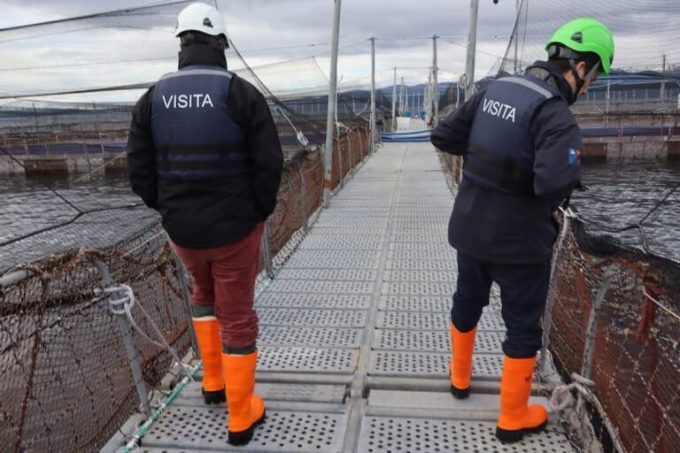
Image: Inspectors from the National Fisheries Service (SERNAPESCA). By Nicolás Sepúlveda
Sernapesca oversight
The public institution that carries out the most comprehensive oversight of the industry is Sernapesca, which reports to the Ministry of Economy. Although the Undersecretary of the Armed Forces and some Navy agencies also have oversight responsibilities, these relate to specific issues concerning concessions in lakes, rivers, and the sea.
For this investigation, we traveled to the Magallanes Region and learned firsthand how Sernapesca officials carry out their oversight. According to them, the pandemic marked a turning point because a remote oversight system was implemented that improved the process.
Every day, salmon farming production centers must upload their data to the Aquaculture Inspection Information System (SIFA), which allows Sernapesca inspectors to monitor the progress of items such as salmon mortality and growth.
At the same time, they carry out remote inspections. Officials can access the cameras carried by certifiers, samplers, or laboratory personnel who visit the centers. This is possible thanks to satellite internet access.
The third type of inspection is in person, which is difficult in a region like Magallanes—the largest region in Chile, covering 132,000 square kilometers—due to the extreme southern climate, which does not always allow inspectors to navigate to the centers. Nevertheless, officials told Mongabay Latam that they try to inspect each center in person at least once a year. They prioritize those located within protected areas.
The director of Sernapesca in Magallanes, Ximena Gallardo, says that as enforcement improves, the industry’s behavior improves.
“The sector’s behavior has been changing in line with the sanctions that have been applied, which are the result of effective oversight,” she says. For this reason, she adds, “the industry has been adjusting its behavior to reflect this reality.”
In general, he says, in Magallanes—Chile’s second most important region for the industry, with 132 concessions granted and between 40 and 50 centers operating simultaneously—environmental damage caused by salmon farming has not been the norm.
“Crimes involving environmental damage associated with salmon farming have not been the norm here in the region so far,” although he acknowledges that “any activity carried out in the marine environment, or on the seabed, naturally has an impact. Now, if that causes environmental damage, those are situations that we, as a service, are obliged to report to the criminal authorities.”
The complaints filed by Sernapesca are not necessarily for direct environmental damage. Those that have been brought before civil courts, for example, are mostly for providing false information to the authorities. According to Ximena Gallardo, during 2025 they did not detect overproduction at the centers, something unprecedented since 2018.
This could be explained by the online monitoring system (SIFA), which allows Sernapesca to warn a center when its indices indicate that it is on track to exceed the legal production limit.
Despite the progress, leaders of environmental organizations and scientists who spoke with Mongabay Latam point to “historical illegalities,” irreversible damage to the ecosystem, and structural problems in regulating salmon companies. In fact, in August 2024, the Comptroller’s Office found that Sernapesca had failed to control 170 salmon farming concessions that had expired but were still operating.
Cermaq’s defense: “We have cutting-edge technology”
Raúl Rivera, head of production at Cermaq, the salmon farming company owned by Mitsubishi, did speak with Mongabay Latam. According to him, criticism of the industry is due to “misinformation.”
Rivera gave his version of events in October last year, when we accompanied Sernapesca officials in Magallanes to inspect the production center that Cermaq operates on Juan Island, some 140 kilometers northwest of Punta Arenas, Chile’s southernmost regional capital.
“Cermaq is part of the Mitsubishi group, a Japanese company, and its main ally, or one of its main allies, is compliance with current regulations. Cermaq, or Mitsubishi, ‘prefers’ to comply with regulations and perhaps forego income. Regulations and people’s safety come first,” he said.
Rivera adds that the historical criticisms levelled at the industry, such as the use of antibiotics in fish and the escape of tens of thousands of salmon from several farms, do not apply to his company. “All the farms we currently have in the water here in the region are antibiotic-free. And when necessary, medication is administered and can be administered on a partial basis. If a cage has a disease, only that cage is medicated (…) all the farming centers, in addition to having the fish net, also have a sea lion net, they have a perimeter fence, which is to prevent mammals from entering or escapes. We, and most of the industry, have state-of-the-art technology,” he said.
But the SMA data reviewed for this report tells a different story: Cermaq has faced 15 sanctioning proceedings due to overproduction of salmon at its centers.
Cermaq did not respond to the specific questions we sent them about the inspection processes.
Marine pollution
The increase in sanctions in recent years has not been solely due to overproduction. Among the most serious is one opened in April 2020 against Sociedad Comercial Agrícola y Forestal Quimeyco Limitada on five charges—three minor, one serious, and one very serious. The latter was for modifying the Piscicultura Quimeyco project, located in Pucón, without obtaining a favorable environmental rating or environmental permit.
Inspectors found that, although the project had two production cycles of six months each, with a total production of 120 tons per year, this was exceeded between 2015 and 2019 by more than 100% in all years, reaching a maximum of 316% in 2017, according to information provided by the company and subsequently corrected by the SMA. As a result, food consumption exceeded the authorized limit, as did the production of sludge (waste) permitted by the environmental permit. Therefore, it was considered that the project had been modified without permission and was not just another case of overproduction.
The company submitted a Revised Compliance Program (PdCR) to remedy the irregularities committed, but this was rejected by the SMA. Following this, they appealed to the Third Environmental Court to have the measure overturned. However, the court rejected the claim, upholding the decision made by the Superintendency.
Alex Muñoz, an environmental lawyer and former director of the NGO Oceana Chile, said that the seabed under the cages is “tremendously affected by the large amount of sediment that falls from these open cages, including salmon feces and uneaten food.” “This covers and ultimately kills cold-water corals, algae, and many species that live on the seabed,” he explained.
Another case involving a very serious offense was committed by the Norwegian salmon giant Mowi. In October 2018, disciplinary proceedings were initiated against it on two charges, the most complex of which was for failing to maintain appropriate safety conditions at the Punta Redonda Farming Center, located in the Los Lagos Region, which resulted in the mass escape of more than 690,000 salmon.
The salmon farm subsequently recaptured around 39,000 salmon, equivalent to 5.54% of the recorded escape. The case is currently ongoing. Mowi did not respond to questions sent for this report.
Muñoz, also former director for Latin America at National Geographic Pristine Seas, said that the escape of salmon has a profound impact on the ecosystem: “As they are carnivores and an exotic and invasive species, once they reach the open sea they begin to prey on native species, such as sea bass and other species.”
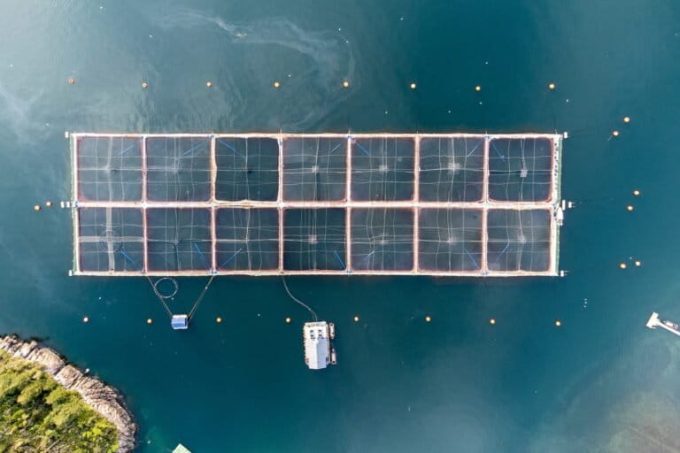
Image: Salmon farm Reloncaví Estuary. By Angel Cristi
A political problem
The tension between the industry and the environmental authority has escalated into a political problem. Complaints from salmon farm owners are splashed across the newspapers. Glenn Cooke, owner of Cooke Inc, a Canadian salmon farming company operating in Chile since 2008, told El Mercurio newspaper a few weeks ago: “We have a problem with the Chilean regulatory system (…) today the Chilean industry is probably the most regulated in the world.”
His complaint stems from a sanctioning process initiated by the SMA after it discovered that Cooke was overproducing at its centers, and that two of them were operating within the Laguna San Rafael National Park and Biosphere Reserve. The sanctions included the suspension of operations at those centers.
The lawyer representing Cooke in court, David Cademartori, from the Barros & Errázuriz law firm, did not respond to the questions sent to him for this report.
In any case, the SMA is not the final decision-maker. It is common practice for the industry to appeal its rulings in environmental courts. This is what Cooke did when its centers in the Aysén Region were shut down. At the end of last October, the Third Environmental Court ruled in its favor.
Steven Rafferty, CEO of Cermaq, Mitsubishi’s salmon farming company, which is expanding globally, told Salmon Expert: “In Chile, we will not reduce volume, but we are cautious about growing until we have more appropriate regulations that support the industry, rather than the current situation, where regulations add unnecessary costs and bureaucracy to operations.”
The business complaint could take a turn with the political change currently underway in Chile. In March, President-elect José Antonio Kast will take office, promising to deregulate the various industries operating in the country to boost economic growth. In early January, at a meeting between Kast and business leaders, Loreto Seguel, executive president of the Salmon Council, the other trade association representing salmon farmers, praised the new president: “He has shown his interest in promoting growth in Chile,” she said, according to El Mercurio.
Before being elected, Kast met with the salmon industry and stated that “substantive deregulation” was necessary to boost the industry’s growth.
This promise contrasts with the hundreds of complaints and breaches that the industry has accumulated in recent years. | Read the full report and its infographics at Mongabay Latam (in spanish)