
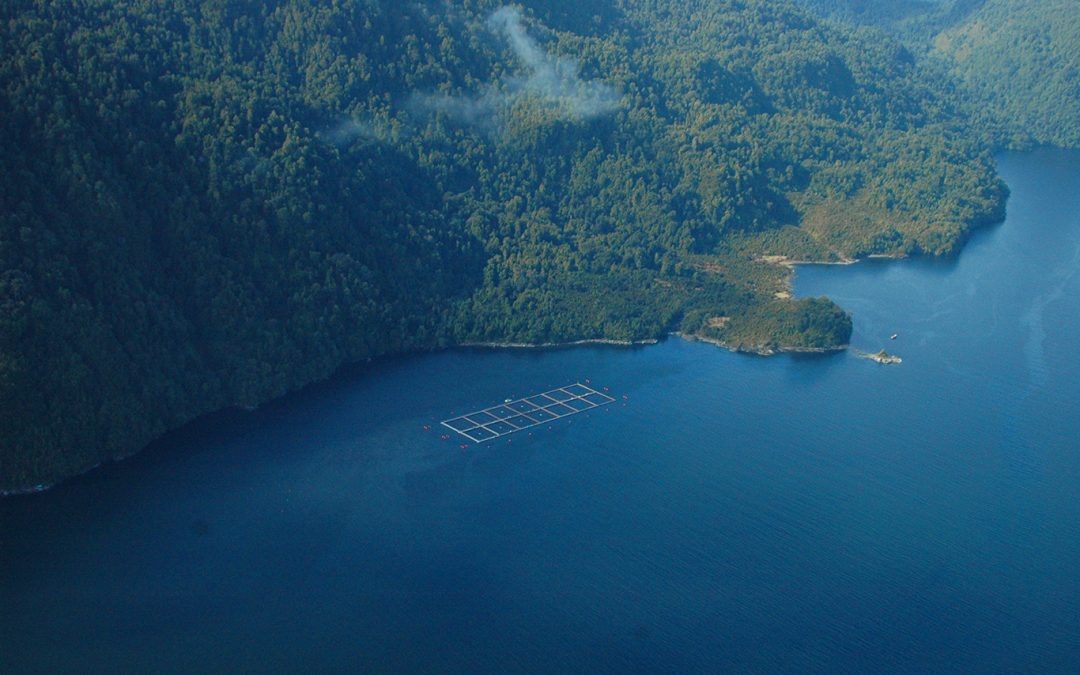
A new investigation by the Salvemos la Patagonia campaign reveals that national parks and reserves in Patagonia—created to conserve unique ecosystems—have instead become key zones for the expansion of the salmon industry.
While the Chilean salmon industry as a whole grew 4% annually between 2001 and 2023, production inside protected areas increased nearly 30% per year over the same period.
For decades, Chile has built an international reputation as a country committed to nature conservation. It has expanded its network of protected areas and ratified global agreements such as the Washington Convention, which prohibits industrial activities in national parks. These achievements have been highlighted widely on the global stage.
However, data gathered by the new study from Salvemos la Patagonia, conducted by Fundación Terram, shows a starkly different reality: 409 salmon farming concessions have been granted within protected areas, of which 309 are currently active. These active concessions produced 3.2 million tons of salmon between 2001 and 2023.
The report, “Harvest of salmonids in protected areas of Chilean Patagonia: impacts, actors and trends,” authored by Cristopher Toledo and Blanca Valdés, analyzed more than two decades of official data. “This is clear structural evidence: protected areas have become a central gear in Chile’s salmon farming model,” says the economist.
On average, around 17% of all national salmon production occurs inside national parks and reserves. But the most striking finding is the pace of growth: while the industry overall grew 4% annually, inside protected areas production soared at nearly 30% per year.
“The very ecosystem characteristics that justified protection—clean waters, low human intervention, high ecological value—are boosting industrial productivity,” Toledo explains. “Spaces meant to safeguard biodiversity are being used as highly efficient production platforms.”
The study also confirms that all concessions were granted after the creation of the national parks.
Corporate concentration inside protected areas
The investigation shows that more than 80% of the biomass harvested inside protected areas is concentrated in just a few companies. Toledo warns: “This is a small group of actors using a public good without paying a special fee or differentiated environmental compensation for operating in these zones.”
This concentration, he adds, is not just an economic observation: “It creates a powerful incentive to remain inside these areas, because this is where growth rates are highest and where operational impacts may be less visible.”
The protected area with the most concessions is Las Guaitecas National Reserve in the Aysén Region, with 221 active centers and over 100,000 tons harvested per year on average. Companies such as Multi X S.A., Salmones Blumar S.A., Australis Mar S.A., Exportadora Los Fiordos Ltda., Cultivos Yadran S.A., Aquachile S.A. and Mowi Chile S.A. together produced 1.9 million tons between 2001 and 2023, representing roughly 87% of total production inside the reserve.
In second place is Kawésqar National Reserve in the Magallanes Region, where production skyrocketed after its creation in 2018, surpassing 130,000 tons in 2022. Aquachile Magallanes SPA, Australis Mar S.A., Multiexport Patagonia S.A. and Cermaq Chile S.A. together produced over 500,000 tons between 2009 and 2023, about 93% of the average annual volume harvested there.
Together, these two reserves account for nearly 80% of all salmon production inside protected areas in Chile over the last two decades.
Toledo sums it up clearly: “The current management of protected areas in Patagonia is paradoxical. We create these places to protect nature, but in practice we are using them to sustain a highly intensive industrial model.”
One of the study’s most striking conclusions is the difference in production between centers located inside and outside protected areas during sanitary or environmental crises.
During events such as the ISA virus, harmful algal blooms, and even COVID-19, production outside protected areas fell by 28,000 tons. Inside protected areas, the opposite happened—harvests increased by roughly 43,000 tons during the same events.
Toledo is cautious about interpretation: there is no proven causality, but a “robust statistical association” showing that centers located inside protected areas withstand crises more effectively.
Why are industries operating inside protected areas?
Diego Rojas, environmental lawyer for Salvemos la Patagonia and Fundación Terram, explains that the presence of salmon concessions in protected areas “directly contradicts the Washington Convention, which prohibits industrial activities within national parks.”
“The presence of the salmon industry in national parks goes against both international frameworks and the SBAP Law,” he adds.
In the case of national reserves, the picture is not much clearer. “Although certain sustainable uses may be allowed in reserves, the scientific evidence on salmon farming impacts makes their presence legally questionable.”
Furthermore, the SBAP Law, passed in 2023, does not provide tools to reverse these installations.
“The risk is clear,” Toledo warns. “If we don’t change this model, protected areas will continue absorbing the impacts of an intensive activity that was never designed to coexist with fragile ecosystems.”
Finally, Rojas stresses that “there must be a public strategy that objectively evaluates the real compatibility of these concessions and allows their removal if necessary.”